

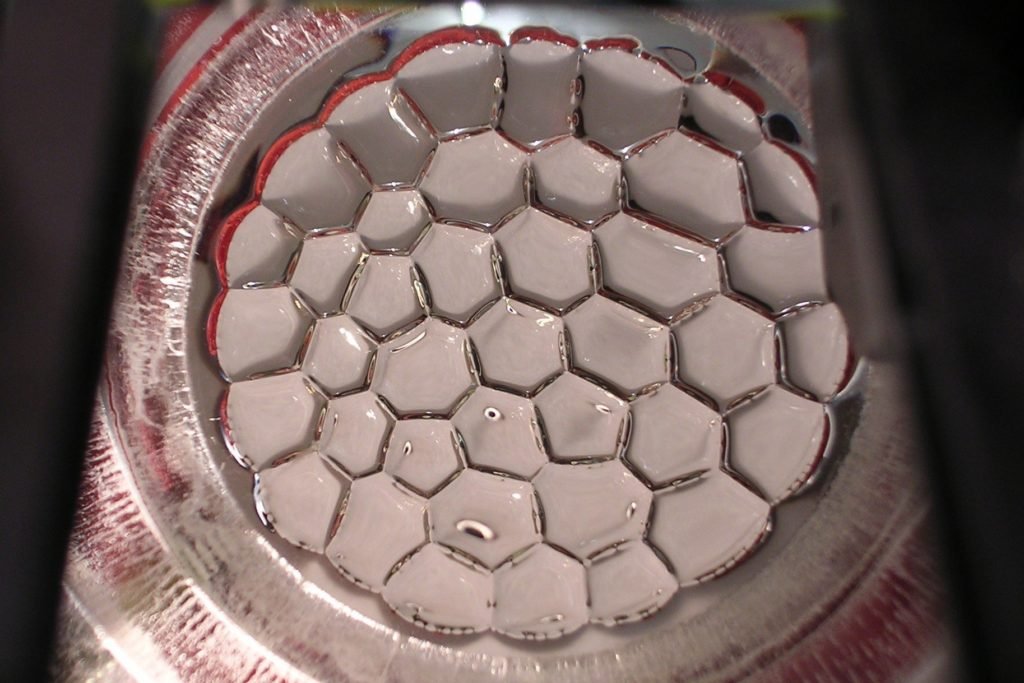
When a specific kind of electrically charged particle travels between a pointy electrode and a flat electrode; but instead of completing that journey it bumps into a puddle of oil, an electric honeycomb is formed.
An electric honeycomb consists of a polygonal pattern which many physicists refer to as the ‘rose-window instability’. The reason why it’s called that is because it resembles the pattern seen on the glass of different Gothic churches. These patterns occur as a reaction towards the natural forces working together to move an electric charge.
The pattern reveals information about how electric charges move through different kind of fluids. By studying these patterns, engineers can discover ways to develop modern technology for printing, biomedicine, and heating. One more thing that this pattern says is that even the tiniest of things in the world are seeking stability. From the smallest atom to human beings, everything in the world is looking for stability. Similar patterns can be seen in soap bubbles, honeycombs, and fly’s eyes.
Although physicist already knew about the phenomenon of the electric honeycomb, the process came to light after Muhammad Shaheer Niazi’s research. Niazi is a 17-year old high school student from Pakistan who took part in the International Young Physicists’ Tournament in 2016. He duplicated the formation of the electric honeycomb and even created photographs of the process. He presented his work at the tournament and later his work was published in the journal Royal Society Open Science on Wednesday.
A science article about my research in the @nytimes “this is frustrated lightning”-A.perez (so true) https://t.co/yMYoGIPXTi
— M.Shaheer Niazi (@M_shaheer_Niazi) October 5, 2017
How is the honeycomb formed?
Every electronic device in our home consists of capacitors which are used to store electricity just like batteries. Electricity in the capacitor travels from the top electrode to the bottom electrode while passing through an insulator.
Similarly, the honeycomb also behaves like a capacitor in which the top electrode is a needle which emits high voltage on a layer of oil which is present on the ground electrode referred to as the floor.
The emission of high voltage takes away electrons from air molecules and creates a ‘corona discharge’. The extracted electrons and ions are then sprayed like a water fountain on the oil surface. As explained in the behavior of a capacitor, the electrons tend to move towards their ground electrode but as soon as they strike the oil surface, they are stuck there as oil in not a good conductor of charges. The tendency of these electrons to strike the ground electrode is compared with the tendency of lightning to hit the ground.
Alberto T. Pérez Izquierdo, a physicist at the University of Seville in Spain said:
“We can say this is frustrated lightning”
After the striking of ions on the oil surface, more and more ions accumulate the surface due to which the striking force increases till it reaches a point when a hole is formed in the oil surface leading to the ground electrode. However, the oil loses its even surface. In order to balance equilibrium, dozens of polygonal patterns develop over the oil surface within milliseconds. These polygons help maintain the overall energy of the system by keeping the gravity and the electric field equal.
Niazi proves that the ions were moving
In order to prove the above stated fact, Niazi took a picture of the shadow of the wind formed by the movement of the ions as they were released from the needle. He also recorded the heat which he assumed to be coming from the friction the ions faced when they travelled through the oil. Statistics showed that the heat kept on increasing after the ions were released from the needle even after the development of the honeycomb.
These images and a thorough research by such a young scientist alarmed Dr. Pérez Izquierdo. No scientist has ever observed a temperature variance on oil’s surface and identifying the source of that temperature hasn’t been done before. Praising Niazi for his outstanding discoveries, Dr. Pérez Izquierdo said,
“I think it’s outstanding for so young a scientist to reproduce these results”
Niazi is excited to explore the honeycomb even further as he continues to study it. He said that he is aiming to earn the Nobel Prize in the future.
Source: New York Times