

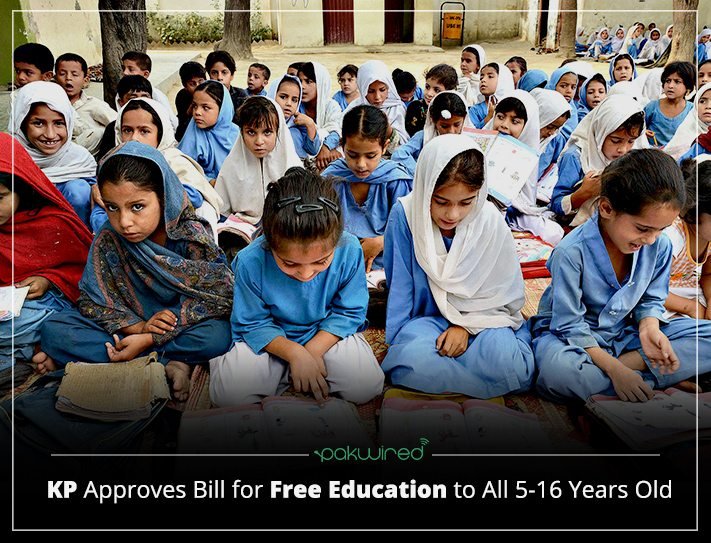
Officials in Khyber Pakhtunkhwa have reported that the Elementary and Secondary Education (E&SE) Department of KP has approved the bill on compulsory and free education at the primary and secondary level. According to this bill, free education would be provided to the children between the age bracket of 5-16 year.
E&SE was of the view that this bill was formulated as a legal responsibility of the Province to educate its children. In its favor, respective provincial assemblies of the other three provinces have already passed an agreement. Nevertheless, popular parties in KP have earlier on been unable to achieve legal requirement, said the officials.
Also Read: Relief for parents as KPK ceases advance school fees for summer
According to the Constitution, article 25A states:
“The state shall provide free and compulsory education to all children of the age of five to 16 years in such a manner as may be determined by law”
The aforementioned article had been added into the Constitution through its 18th Amendment.
Three Respective Provinces Have Already Signed Related Laws
After being approved by the provincial government, further approval will be followed by the next cabinet meeting, the officials reported. Later, it would be presented in the provincial assembly.
Due to the unavailability of Minister for Elementary and Secondary Education Mohammad Atif Khan, the proposed bill had been called off in the previous cabinet meeting on 24th January 2017.
Quick Read: Smart School System to Revolutionize the Education System of Pakistan
According to the draft bill, parents would be facing imprisonment for a month or shall be subject to a fine, if they don’t send their children to school. In addition, they might pay Rs100 every day if their children don’t go to school or be imprisoned daily.
According to the bill, section 5 states:
“Government may, by notification, constitute a School Attendance Authority (SAA) for each school for the purpose of this act and shall consist of members, as may be determined by government”
Moreover, it states that SAA will help and encourage every child to come forward and study in a school according to the law.
To make things easier, a list of acceptable excuses is available for not attending school (for a short period). The list is related to situations where a child’s absence from school could be excused. The reasons include health issues, mental disorder or unavailability of school within the two kilometer radius of the child residence.
Establishment of Taleem Fund
With the help of this bill, SAA would also start a Taleem Fund maintained at a pre-arranged bank. The fund will gather charity for the welfare of the students.
According to the bill, section 7 (2) states:
“The Fund (Taleem Fund) shall consist of grants made by the federal, provincial, district governments and all voluntary contribution from the philanthropists, alumni, students and parents”
A survey is in progress to determine the number of students who do not have school in their areas. Once the survey is complete, government schools would be established in those areas to execute the law there. Additionally, this survey is expected to be completed by the end of February.
The provincial government will enroll the out-of-school children in private schools in the areas where there are no government schools.
The officials were also inquired about the private schools in such areas. The officials responded that the educational department would establish community schools in the area. They answered that “over 1,436 community schools had already been functioning in the province”.
According to them, it is their legal responsibility to provide basic, mandatory and free education to every citizen and provide them with same level of experience.
Source: Dawn | image: A Majeeda/AFP