

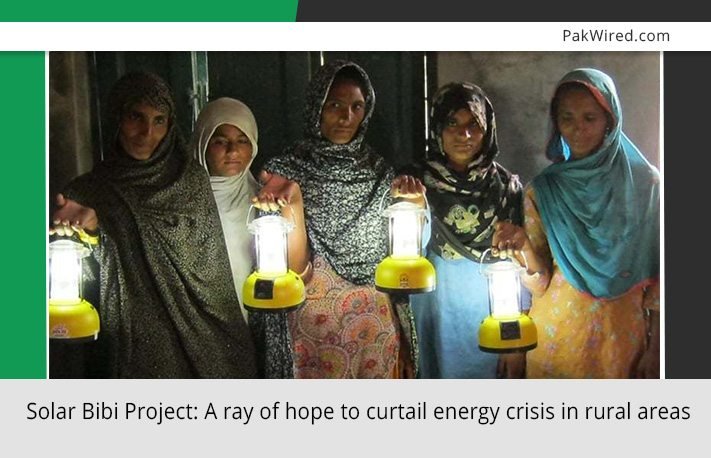
It would not be an understatement to say that employment opportunities for the underprivileged women are very minimal in Pakistan. There are limited avenues for women entrepreneurs to start a living on their own. Nonetheless, Solar Bibi project is initiated to provide a relief to these women who are struggling to earn a living due to energy shortfall in rural areas. This project is a collaborative effort by Pakistan Council of Renewable Energy Technologies (PCRET) and Ministry of Science and Technology.
Solar Bibi aims to empower women by creating awareness about benefits of solar energy. As a result, they can uplift their financial condition and also play their role in reducing energy shortage in some areas.
What Solar Bibi is all about?
Under this project, women will be asked to operate and maintain solar charging stations in their homes. These solar charging stations will assist these women to start their home based projects. Thus, the name Solar Bibi matches with the essence of the project.
The project will also expand to other areas where women are restricted to work after sunset due to electricity issues. This project was initiated by Samina Fazil, Founder and President Islamabad Women Chamber of Commerce and Industry (IWCCI). Primarily, this is suited for widows and financially dependent women. IWCCI, Centre of Information Technology, Centre for Women Entrepreneurship, and Self Employed Women Association are the three parties involved.
Training sessions will be conducted by the officials for three days starting this week with an initial bunch of 50 Solar Bibis. Fateema Aneela, the E-Solar project head, stated they plan to train 1,000 women as Solar Bibis all across Pakistan. This was jointly coordinated by PCRET and the ministry.
Social and economic empowerment
Director General (ICT) Centre of Information Technology, Ammar Jaffri quoted World Bank saying that roughly 44 percent households in Pakistan are not connected to national grid, out of which 80 percent are from rural areas only. Jaffri also said:
“Our target is to provide sustainable energy to off-grid areas and we especially want to empower women in these areas through the project”
He also stated that the government should support off-grid solar projects and create awareness about renewable energy. This will reduce pressure from the national grid.
Solar Bibi is a prime example of small projects which could change lives in rural areas of Pakistan. This has twin benefits, it does not only uplift the financial condition of the underprivileged but also improves the energy supply in Pakistan, Lastly, the most vital impact is that it can empower women entrepreneurs in rural areas.