
Businesses reaching out to Asian mobile phone users are caught in a bind. While the region’s average mobile internet speed is lower than the global average, the story varies across the continent.
China, Taiwan, Singapore, Hong Kong, Japan, and South Korea lie above that average, while Malaysia, Thailand, Philippines, and Indonesia lie below (with Vietnam rounding out the bottom). In these countries, mobile internet is slow, and internet usage costs are high. So, does it make sense for you to spend money to target a small audience that might not even see you?
SMS to the rescue
-

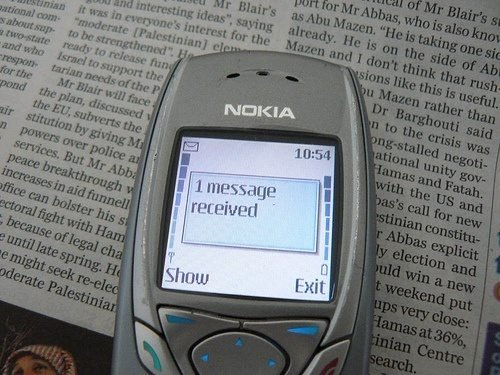
The humble SMS is more resilient than you think. Photo credit: Ken Banks
Let’s take a step back.
Smartphones and feature phones are fundamentally different, yet they share a common feature: sending and receiving SMS.
People tend to forget that in a world with smartphones more powerful than the computer that took us to the moon, you still need an internet connection to make it work. And yet, we have almost as many cellphones as there are people on the planet, and all of them can receive SMS. All of them.
If you’re looking for a marketing tool, mobile banking tool, or more, SMS ticks all the right boxes; it’s cost effective, efficient, and easily scalable (there’s no proprietary software requirement here). Crucially, there’s no internet connection needed.
Most of us are aware of SMS alerts for OTPs (one time passwords) and transactional alerts. But companies are using SMS in unique and clever ways to not only help customers, but also themselves.
-

Industries using SMS messaging as part of their business models. Photo credit: Clickatell
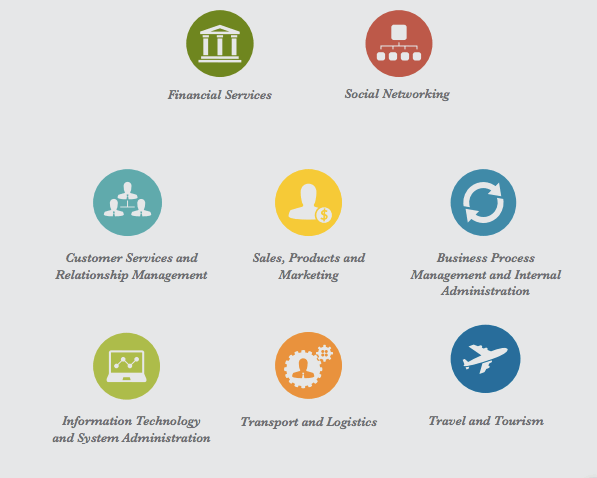
Clickatell recently published the second edition of their 101 Business Uses for SMS report, with some of the more interesting Asian examples listed below:
- A Cadbury’s vending machine in Mumbai allowed customers to purchase via SMS.
- SMS ticketing services are provided by Mobitel in Sri Lanka and the Indian Railways.
- Australian teen magazine Girlfriend got readers to register for their ‘Girlfriend VIP Club’. As members, they could send free SMS messages from the magazine website to get special offers and discounts.
- Rosspirtporm offers Russians a service where they can text a serial number of a bottle of vodka to find out of it’s authentic or not.
- Australia’s The Donut King offered free coupons to customers who texted in, in response to their radio and outdoor campaign. The SMS coupons were redeemed 10 times more often than actual ones.
How effective is it?
The numbers are clear; 98 percent of text messages in APAC are opened within ten minutes, compared to less than 54 percent of push notifications and 27 percent of emails.
Moreover, SMS is built for mobile, which is why 98 percent of all texts are read by mobile users (versus 29 percent of tweets). Combining a potential audience of 6.8 billion cellphones, with a solution that requires your audience to have opted in, means your per-customer marketing effectiveness skyrockets. After all, SMS reaches 100% of every user with a phone, whereas Internet penetration is not 100%.
Still, SMS can’t create an impact quite as well as outdoor advertising does, since people tend to delete a text once they’ve read it, unlike Facebook posts or tweets. But SMS serves a different purpose. It’s not about the branding, it’s much more tactical than that. It’s about generating leads and sales, letting people know what the best deal is right now, and where. And as with any other form of marketing, it doesn’t work in a silo (The Donut King’s campaign is a good example).
Despite these perceived weaknesses, there isn’t much you can’t do with SMS today. It’s not only mobile, instant, and two-way, but it is also highly location and time sensitive, reaching those who’ve opted in.
How to
Clickatell explains the best approach to SMS messaging with these six steps:
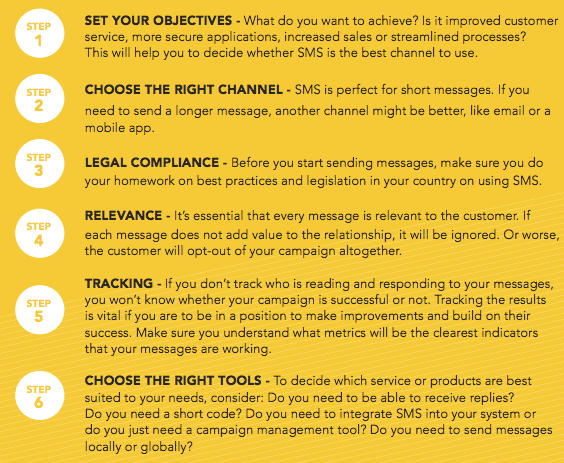
Photo credit: Clickatell
Founded in 2000, Clickatell is the pioneer and innovator of SMS. They are the leader in global mobile messaging, helping businesses connect and interact with their customers. Clickatell is composed of two core businesses – Clickatell Messaging and Clickatell Mobile Transaction Solutions (MTS). Clickatell Messaging helps businesses with mobile customer engagement using SMS. Clickatell MTS offers simplified mobile transactions for services such as pre-paid mobile top-ups.
Clickatell was founded with a clear mission: to make it easy for businesses to connect with their mobilized customers, regardless of where they are located. Although SMS is widely available and easily understood, it is however a challenging mobile channel to reliably operate on a global scale. A robust SMS delivery platform was built by Clickatell that today delivers millions of messages per day, through connections to over 1000 carriers. They ensure global reach to over 220 destinations and six billion consumers. Combined with their dedicated support teams, Clickatell messaging now powers SMS-based mobile engagement for over 15,000 of world’s brands, from startups to global enterprises.
Clickatell is a privately held company headquartered in Silicon Valley (Redwood City), CA with offices in Cape Town, South Africa and Lagos, Nigeria. They are funded by Sequoia Capital and a group of International venture capital firms.
This post was originally published at: techinasia.