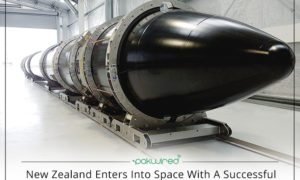

New Zealand has been in the news for its scenic views but recently a company called Rocket has brought the country into the race of battery-powered 3D printed rocket. Rocket Lab is a Silicon Valley sponsored company which launched its first ever flight in the remote area of Mahia Peninsula, New Zealand, last week.

A supplied image of the launch and maiden flight of a battery-powered, 3-D printed rocket built by Rocket Lab, a Silicon Valley-funded space launch company, at New Zealand’s remote Mahia Peninsula, May 25, 2017. Rocket Lab/Handout via REUTERS
After four years of preparation, the company finally launched a low cost 3D printed rocket. By doing do, they also achieved a milestone in the space industry. This step would not only reduce the financial cost but would also remove the logistic issues associated with space testing. Additionally, it could also make New Zealand a new hub for space technology.
Also Read: Pakistan’s first hybrid rocket ‘Raheel1’ tested successfully
Rocket lab covered the launch moment by moment through its official Twitter account under the hashtag #ItsaTest.
#ItsaTest pic.twitter.com/JI4M6iTqiC
— Rocket Lab (@RocketLab) May 25, 2017
The firm will enable many other satellite companies to enter the space on a regular basis owing to low cost benefits.
According to the Chief Executive and Founder of Rocket Lab, Peter Beck:
“Our focus with the Electron has been to develop a reliable launch vehicle that can be manufactured in high volumes – our ultimate goal is to make space accessible by providing an unprecedented frequency of launch opportunities”
Rocket Lab received a green signal from U.S. Federal Aviation Administration which has been monitoring the flight. The company had been working for the test launch for many years; however, it materialized only last week when the weather permitted the company to launch a test flight.
New Zealand has established a new rocket legislation and a space agency in order to commercialize this space testing and to make itself a space hub.
Quick Read: NASA released a ton of software for free
Since this is a Los Angeles based company so it had limited opportunities to conduct test flights in the U.S due to high population density. Conversely, New Zealand with a small population of only 4 million has a lot to offer as it is located in the South Pacific. In addition, with Antarctica on its South, the country is geographically positioned well to send satellite flights around the orbit.
The locals in the remote area are skeptical about the rocket flight as some public areas have been blocked. A Mahia farmer Pua Taumata expressed his views:
“People come to Mahia so they can go to the beach. It’s been chopped off now and by the sounds of it one of these rockets are going to be launching one every 30 days so they’ve taken over our lifestyle”
However, they are also hopeful about the potential opportunities as they said:
“I’m for technology … a lot of things could come of it through education. It gives our children something different in their careers. Nobody thought to get into the space industry (before now)”
Rocket Lab and its efforts
Rocket Lab is primarily a Los Angeles and New Zealand based company. It is one of the 30 companies and agencies worldwide which are developing small satellite launchers. This is a feasible alternative to larger and more pricey space launches which costs around $50 million for a separate service.
Also Read: Moon trip is no more a dream
The company said it has received $148 million funding. Moreover, it is currently valued at $1 billion. The company has a prestigious customer base; including NASA, earth-imaging firm Planet and a few start-ups like Spire and Moon Express.
Going forward, Rocket Lab will conduct two more tests before going for a full-scale commercial launch before the year ends.