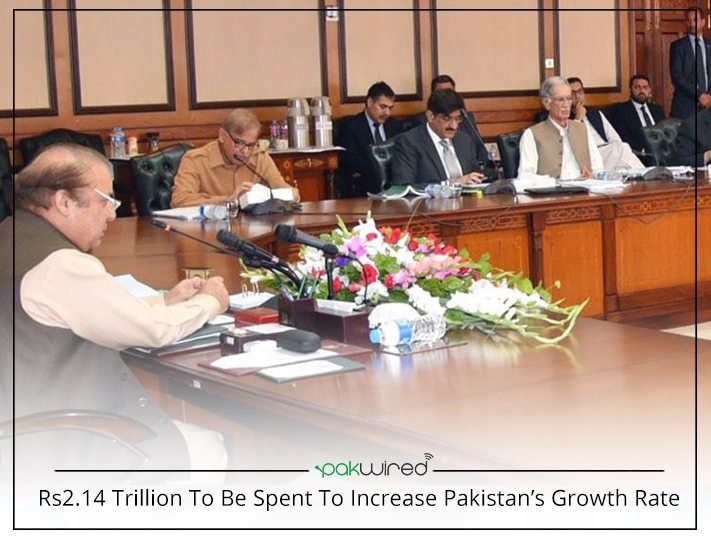
During the meeting between Prime Minister Pakistan, Nawaz Sharif and the National Economic Council; the total development budget of Pakistan was suggested to be increased to whopping Rs2.14 trillion. The sudden increase in the country’s budget is expected to increase the growth rate of the country by 6%.
The budget has been allocated among different development plans according to their needs.
Rs30 billion have been set aside for PM’s Global Sustainable Development Goals
Rs12.5 billion each have been allocated for the Electricity for All
Rs12.5 billion have been allocated for the Clean Drinking Water for All
Rs40 billion has been set aside for Special Federal Development Programme
Rs45 billion each have been allocated for Security Enhancement and Relief
Rs45 billion have been allocated for the Rehabilitation of Displaced People in Pakistan
The meeting was attended by the Prime Minister along with the chief ministers of AJK, FATA, GB, and KP. The development plan for macroeconomic framework for the year 2018 was also approved during the meeting. The plan is expected to increase inflation from 4.1% to 6% while increasing total investments of GDP from 15.8% to 17.2%.
Also Read: MoU signed with GoP – Alibaba Group officially steps in the Pakistani market
Federal Public Sector Development Programme (PSDP)
Dawn reported that during the meeting, the Federal Public Sector Development Programme (PSDP) was also approved by the NEC at Rs1.001 trillion. This is an increased amount as compared to last year where the programme acquired Rs800 billion only.
Minister for Planning and Development, Ahsan Iqbal said that the prime minister also demanded a special position for AJK, FATA and GB in the National Finance Corporation. He said that despite being a part of Pakistan, these areas are not getting the position and financial support they deserve due to legal complications. The prime minister added that there should be a separate fund allocation for these parts of Pakistan.
Read More: ECO Vision 2025 – How does the 13th ECO Summit translate for Pakistan?
Block Allocations for AJK, GB, and FATA
The block allocations for Azad Jammu Kashmir were increased from Rs12 billion to Rs22 billion, the most rapid increase in Pakistan’s provincial economic history. This will greatly help Kashmir to increase its development pace. Other areas also received an increase in financial allocations. Block allocations for GB were increased from Rs9 billion to Rs15 billion. In addition to this, Fata’s allocations were increased from Rs21 billion to Rs24.5 billion. Rs17 billion were also set aside for Baluchistan aiming to provide improved water resources.
The annual development plans have increased by 27% as they were estimated to be at Rs875 billion last year. Their value right now is Rs1.140 trillion. WAPDA and NTDC are also expected to increase the total development of the country up to Rs2.5 trillion as both organizations will spend Rs400 billion from their own pockets.
As part of the development plan, Rs324 billion will be given to National Highway Authority:
Rs414 billion for infrastructure development, Rs43 billion for railways, and Rs44 billion for other means of transportation.
A sum of Rs404 billion would be spent on the energy sector. This will include Rs87 billion from PSDP and Rs317 billion by WAPDA and NTDC. Rs180 billion have been reserved for other China-Pakistan Economic Corridor (CPEC) ventures. Allocations for the social sector have additionally been expanded to Rs153 billion from Rs90 billion. PSDP would be set at Rs866 billion one year from now against Rs655 billions of current year while non-core development spending would add up to Rs135 billion. For the completion of CPEC projects, Rs27 billion has been already assigned.
Mr. Ahsan Iqbal said the activities taken by the PML-N government had conveyed 5.3% GDP development rate following a crevice of 10 years. This proved to be a great accomplishment for the whole country that was caught up in 3% to 3.5% development rate four years prior. He said that steps taken towards macroeconomic stability, energy supply, infrastructure development and human resource development contributed greatly to the increase in growth rate of the country.
Services sector is expected to increase by 6.4% this year as compared to 6% of last year. However, livestock would decrease to 2% growth as compared to 3.4% of last year.
Quick Read: With 20,000 jobs for the locals, Gwadar takes off
Increase in Import and Export
Due to the contraction in leading world markets, export decline came as a big challenge for Pakistan, said the minister. In order to face that challenge, agricultural and industrial developments have been increased. Exports are estimated to increase by 6.4% in the coming year while increasing from $21 billion this year to $23 billion in the next one. Import growth has also been expected to increase by 9.6%.
Hence, the following year exchange shortage has been assessed at $26.9 billion as compared to $24 billion this year while current account deficiency would increment to $10.4 billion as compared to $8.3 billion this year. As a result, next year’s account deficit would amount to 3.1% of GDP of the country as compared to 2.7% of the year, 2017.
The Higher Education Commission (HEC) has also been allocated funds worth Rs35 billion for advancements and development. This will help increase start-ups and provide financial support for different plans including cloud computing, cyber security, and robotics.