News out of the medical research world has it that a Pakistani has just developed a method to detect cancer cells.
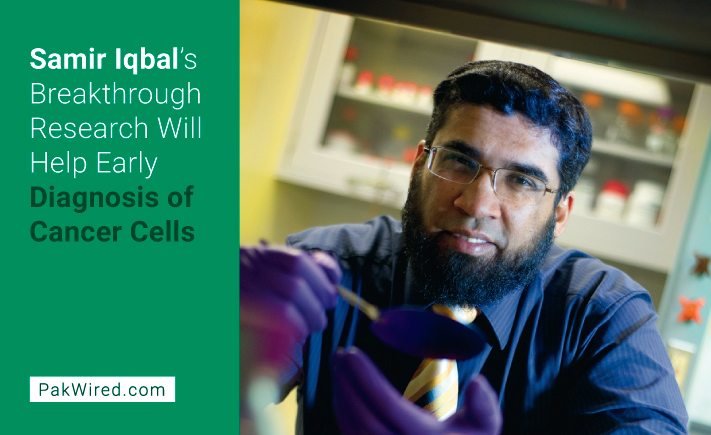
The person is none other than Mr. Samir Iqbal, a Pakistani electrical engineer at the University of Texas at Arlington. Mr. Samir has come up with a detection method for cancer cells that will help improve the early diagnosis of cancer.
Mr. Samir Iqbal and his Breakthrough
Mr. Samir Iqbal – an associate professor at the Electrical Engineering Department of the University of Texas – details his team’s results in a Nature’s Scientific Reports paper titled “Effects of Nanotexture on Electrical Profiling of Single Tumor Cell and Detection of Cancer from Blood in Microfluidic Channels.”
The tool that Mr. Samir and his team have developed tracks cellular behavior in real time. This is done by using nanotextured walls that mimic layers of body tissue.
Mr. Iqbal explained that the team studied multiple layers of human tissue and concluded that they had to create something that would mimic that layering. Mr. Samir said that “The answer was in creating a nanotextured wall that fools blood samples into thinking its actual tissue.”
He added that “We used inherent properties of the cell walls to create a diagnostic tool. The cancer cells behave differently as they come into contact with the nanotextured walls. They dance,”
For this project Mr. Iqbal’s team mates included:
- Young-tae Kim, a UTA associate professor in the Bioengineering Department;
- Muhymin Islam, a STEM doctoral candidate and engineering students
- Mohammad Motasim Bellah
- Adeel Sajid
- Mohammad Raziul Hasan
Mr. Samir is an NED University of Engineering and Technology, Karachi alumnus where he completed his bachelors in 1996. Following this, he received a PhD from Purdue University in Indiana.
Mr. Iqbal is also an adjunct professor in the Department of Urology at UT Southwestern Medical Center, a senior member of IEEE-USA, a member of Biomedical Engineering Society, American Physical Society, American Society of Mechanical Engineers and Biophysical Society.
The Dancing Cells that Help Doctors
Once these dancing cells can be identified, doctors will be able to single out cancer cells and start early treatment; earlier than today’s technology permits.
“Discovering the cancer earlier, before it metastasizes, is essential to surviving cancer… Our device has the potential to do that.” Mr. Iqbal claimed
According to Mr. Khosrow Behbehani, Dean of the UTA College of Engineering “The research aligns with UTA’s Strategic Plan, particularly the focus on Health and the Human Condition. Dr. Iqbal’s device could greatly improve cancer survival rates, which is good news for humanity. There are very few people around the world whose lives have not been touched by this dreadful disease.”
He added that “Dr. Iqbal and his colleagues are bringing engineering innovation to meet the challenge of early cancer detection.”
The research initiated on the back of a $480,000 grant from the National Science Foundation, which sponsored the development of the device. In all, Mr. Iqbal has been successful in getting almost $1.4 million in grant money for his project since 2007 when he arrived at UTA.
Seeing the impact that such a device can have on cancer treatment we salute Mr. Samir’s work and hope he can bring it to the mainstream as soon as possible.