

The Annual KPCB Internet Trends Report is one of the most anticipated reports of the year. In its 22nd year, it features in-depth analyses using a wide range of sources offering insights in to the Internet Economy. The report deck covers 355 slides and offers some great insights of which PakWired have summarised in a previous article. Though the extensive data covers a broad range, none of which should be overlooked, we’ve listed 3 of our key takeaways. When you have time, it’s recommended you head on over and have a read through the full report.
1. Voice Growth & Accuracy Improvement
Voice has been creeping in over the last few years with the introduction of virtual assistants on mobiles. This year’s report shows things are about to get a lot more interesting and futuristic! More recently, Amazon has introduced their Echo home assistant, with Google adding ‘Home’ to the line up and Apple, last to the party with their ’HomePod’. Though very new technologies in a broader sense, the report shows the current significance voice will have in the near future.
If the focus on devices isn’t indicative enough, the report shows Amazon Echo’s installation base at 11 million in quarter 1 in 2017 versus just under 2 million from quarter 2 in 2015. Moreover, May 2016 shows a quantity of ~500 Echo’s skills/use cases versus a colossal 12,000 11 months later in April 2017.
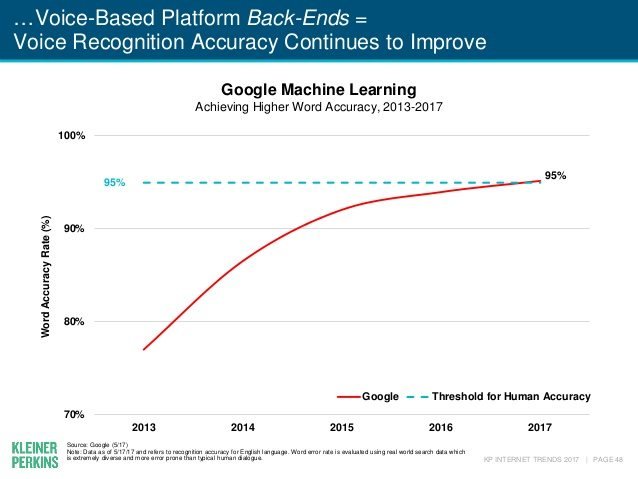
Creating and marketing devices has been backed with a solid improvement in the quality of use too. As shown in the image below, one can see the improvement in Google’s Machine Learning accuracy which is currently at 95 per cent and Google Assistant figures showing that 70 per cent of requests/searches are in natural/conversational language.
2. Rise of Indian Internet Economy
Often we compare development situation in Pakistan to that in India due to geopolitical similarities, so it is always good to see how our neighbours are getting on.

As you will see in the image above, India has become the seventh largest GDP grower at just under 7 per cent. What’s more interesting, ate the figures provided around internet usage — 40 per cent year on year growth at 27 per cent penetration (355 Million Users). These figures leave India trailing only behind China, which is an amazing feat indeed.
Other figures show India is second only to China in Android device usage and Google Play downloads. All this despite the data costs being relatively ‘high’ for a majority of the nation’s 1.3 billion citizens, however, this along with smartphone costs is declining. Even with the high costs data consumed has seen a 9x increase in the past year. It will be interesting to see what the coming years hold for India, and how Pakistan can improve too.
3. The Cloud
In recent times, naturally, the transition of data to cloud centres has increased. Though it may be costly to move from traditional data centres for companies, over time the cost savings will offset maintenance costs, hence a 13% growth of cloud usage between 2013 and 2016.
Further, the report finds that Amazon Web Services (AWS) continues to lead in the cloud platform, but others like Azure and Google Cloud are catching up whilst users are now adopting more than one platform for different use cases e.g. running apps and experimenting etc.
Further contextualising this for a consumer market, a growth in well-designed, cloud companies with intuitive experiences have started to appear and become successful such as Rubrik and Stripe. This high-end experience has started transferring to enterprise solutions too, where enterprise clients are now expecting a better experience from their software — quite the opposite from the traditional enterprise software solutions seen in the past. Moreover, as the image shows below, buying decisions have changed as well as causing higher expectations.

Summary
- Voice is growing and set to grow exponentially with the new hardware available
- India’s growth trajectory is phenomenal and no-doubt its policies and infrastructure have a big part to play in this. What can we learn in Pakistan?
- The cloud transition is still in progress. The competition amongst providers is intense so one has a good choice. In terms of a B2C view, as software engineers, the focus should be on well-designed and intuitive solutions. Buying patterns have changed, so a new approach may be required.